
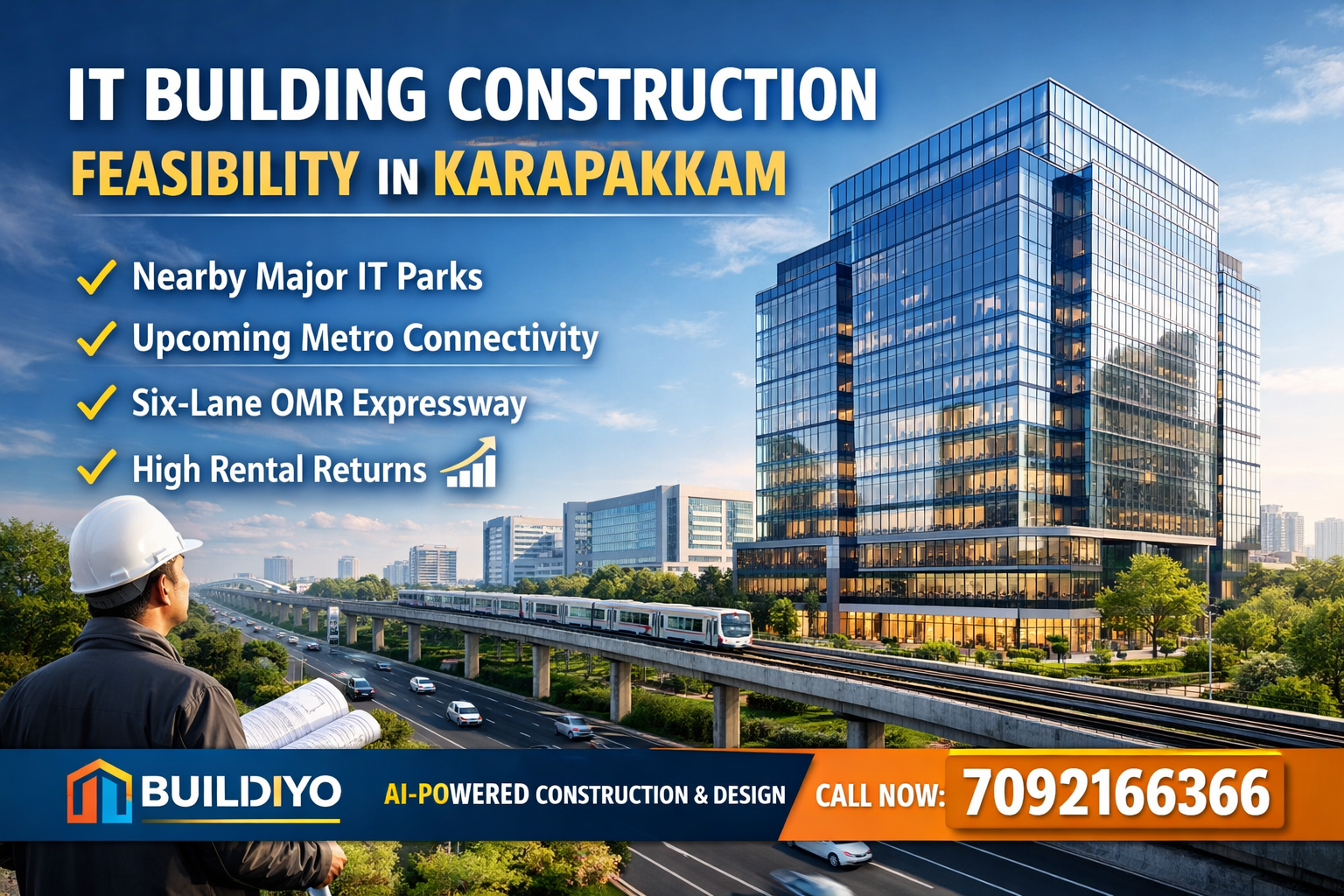
IT Building Construction Feasibility in Karapakkam

Introduction
Karapakkam, located along the prestigious Old Mahabalipuram Road (OMR) in Chennai, has rapidly transformed from a quiet suburban neighbourhood into one of the most sought-after commercial and IT construction hubs in South India. With the presence of global technology giants like TCS, Cognizant, Capgemini, Accenture, and Infosys operating within close proximity, the demand for professionally designed and structurally superior IT buildings has surged dramatically.
For investors, business owners, and IT companies exploring the feasibility of constructing an IT building in Karapakkam, this comprehensive guide covers every critical aspect — from location advantages and regulatory requirements to construction costs and design considerations. Partnering with the best commercial construction company in Chennai is the first step towards turning this opportunity into a profitable reality.
Why Karapakkam Is the Ideal Location for IT Building Construction
Karapakkam’s strategic position on the OMR IT corridor, nestled between Sholinganallur and Thoraipakkam, gives it unmatched connectivity and commercial visibility. The area falls under the Greater Chennai Corporation, which has fuelled rapid infrastructure upgrades including improved roads, sewage systems, and upcoming Chennai Metro Phase 2 connectivity. Here are the key advantages that make Karapakkam a top choice for IT building construction:
- Proximity to Major IT Parks: Karapakkam is surrounded by ELCOT SEZ, SIPCOT IT Park in Siruseri, and multiple tech campuses. IT employees and companies prefer locating within this corridor to minimise commute times and maximise talent accessibility.
- Metro Rail Connectivity (Phase 2): The upcoming Chennai Metro Corridor 3, connecting Madhavaram to SIPCOT, will include a dedicated metro station at Karapakkam. This will dramatically improve accessibility and increase property values for IT buildings.
- Six-Lane OMR Expressway: The Rajiv Gandhi Salai provides a well-maintained six-lane highway with service roads, pedestrian footpaths, and underground utility ducts — ideal infrastructure for commercial and IT developments.
- Established Social Infrastructure: The locality already boasts reputed schools, hospitals, shopping centres, restaurants, and residential townships, making it a self-sustained ecosystem for IT companies setting up offices.
- Rising Real Estate Demand: Land prices in Karapakkam have been climbing steadily thanks to the IT boom and metro expansion, making early investment in IT building construction a strategically sound financial decision.
Feasibility Analysis: Key Factors to Consider
Before breaking ground on an IT building in Karapakkam, a thorough feasibility assessment is essential. Working with the best construction company in Chennai ensures that every technical, financial, and regulatory detail is addressed from the very beginning.
1. Land Selection and Site Analysis
Choosing the right plot is foundational to project success. Key considerations include:
- Plot Size and FSI: IT buildings typically require plots of 5,000 sq. ft. or more. The Floor Space Index (FSI) permitted in the OMR corridor area allows for multi-storey commercial construction, maximising the usable built-up area.
- Road Frontage and Access: Plots with direct OMR frontage or access via well-maintained service roads command premium visibility and ease of entry for vehicles and pedestrians.
- Soil Testing: Karapakkam’s proximity to marshy zones near Pallikaranai means soil bearing capacity must be tested. Sandy or soft soil may require deeper foundations, which will increase structural costs.
- Flood Zone Assessment: Given Chennai’s history of seasonal flooding, ensure the plot is at or above road level and has adequate stormwater drainage provisions.
2. Regulatory Approvals and Compliance
IT building construction in Karapakkam must comply with several regulatory frameworks:
- CMDA/DTCP Approval: The Chennai Metropolitan Development Authority (CMDA) or Directorate of Town and Country Planning (DTCP) approval is mandatory for commercial construction plans, ensuring compliance with zoning regulations and building setback norms.
- Environmental Clearance: For large-scale IT projects exceeding 20,000 sq. m. of built-up area, Environmental Impact Assessment (EIA) clearance from the State Environment Impact Assessment Authority (SEIAA) is required.
- Fire Safety NOC: The Tamil Nadu Fire and Rescue Services Department issues a No Objection Certificate (NOC) based on fire escape provisions, sprinkler systems, smoke detectors, and fire-rated structural elements.
- Building Permit from GCC: Since Karapakkam falls under Greater Chennai Corporation, the building permit application, structural design approval, and occupancy certificate processes go through GCC’s Town Planning Division.
Navigating these approvals seamlessly requires the expertise of trusted home construction builders in Chennai who have a proven track record in commercial and IT building projects.
3. Construction Cost Estimation
Understanding the financial investment required is critical for project planning. As of 2026, construction costs in Chennai vary based on the type, quality, and scale of the project:
- Basic Commercial Construction: ₹2,100 – ₹2,400 per sq. ft. — suitable for standard office structures with functional finishes and basic amenities.
- Mid-Range IT Building: ₹2,400 – ₹3,200 per sq. ft. — includes modern facades, energy-efficient systems, branded fittings, modular workspaces, and server room provisions.
- Premium / Grade-A IT Building: ₹3,500 – ₹4,500+ per sq. ft. — features glass curtain walls, centralised HVAC, smart building management systems, green building certification (IGBC/LEED), and high-end interiors.
- Labour Costs: Labour charges in Chennai range from ₹300 to ₹500 per sq. ft., influenced by the complexity of work, seasonal demand, and skill level of workers.
- Architect and Consultant Fees: Typically 2% to 5% of the total construction cost, covering architectural design, structural engineering, MEP planning, and project management.
For a 10,000 sq. ft. mid-range IT building, the estimated construction cost (excluding land) would range between ₹2.4 Crore to ₹3.2 Crore. Working with top home builders in Chennai who specialise in commercial construction ensures accurate budgeting, transparent pricing, and zero hidden costs.
IT Building Design and Architectural Considerations
The design of an IT building in Karapakkam must balance functionality, aesthetics, energy efficiency, and future scalability. A well-planned design directly impacts occupancy rates, rental yields, and long-term maintenance costs.
Structural Design Essentials
- RCC Framed Structure: Reinforced Cement Concrete (RCC) framed construction using M30 or higher grade concrete and Fe500D TMT steel bars is the standard for multi-storey IT buildings, ensuring seismic resistance and structural longevity.
- Column-Free Floor Plates: IT companies prefer open floor plans with minimal columns to allow flexible workspace layouts. Achieving spans of 8–10 metres requires careful structural engineering.
- Floor-to-Floor Height: A minimum of 3.6 to 4.2 metres floor-to-floor height is recommended to accommodate false ceilings, HVAC ducting, cable trays, and lighting systems.
- Server Room / Data Centre Provision: Dedicated server rooms with raised flooring, precision air conditioning, UPS backup, and fire suppression systems (FM-200 or Novec 1230) are essential for IT tenants.
Facade and Exterior Design
- Glass Curtain Walls: Reflective or low-E glass facades improve the building’s professional appearance while controlling heat gain. Double-glazed units with thermal breaks offer superior energy performance.
- ACP Cladding: Aluminium Composite Panel (ACP) cladding in combination with glass provides a modern, corporate aesthetic at a lower cost compared to full curtain walling.
- Green Building Elements: Incorporating rainwater harvesting, solar panels, STP (Sewage Treatment Plant), and energy-efficient lighting qualifies the project for IGBC Green Building or LEED certification, attracting premium tenants.
Interior Design for IT Spaces
As an AI-powered construction, architecture, and interior design company, Buildiyo brings cutting-edge interior design solutions tailored specifically for IT workspaces:
- Modular Workstations: Pre-fabricated modular furniture systems that can be reconfigured quickly as teams scale up or down.
- Breakout and Collaboration Zones: Informal meeting spaces, cafeterias, and recreation areas that boost employee productivity and well-being.
- Acoustic Treatment: Sound-absorbing panels, carpet tiles, and partition systems to create quiet zones for focused work alongside open collaborative areas.
- Smart Building Integration: IoT-enabled lighting, HVAC, and access control systems that optimise energy use and enhance security.
Infrastructure and Utility Planning
An IT building’s operational success depends heavily on robust infrastructure and utility systems. Here is what needs to be planned:
- Electrical Load Planning: IT buildings require high electrical loads (typically 8–15 watts per sq. ft.) for servers, workstations, lighting, and HVAC. A dedicated transformer and HT connection from TANGEDCO is essential.
- DG Backup: 100% diesel generator backup ensures uninterrupted operations. Consider a combination of smaller DG sets for redundancy and fuel efficiency.
- Water Supply and STP: Bore wells, overhead storage tanks, and a Sewage Treatment Plant (STP) with capacity aligned to occupancy levels. Chennai Metrowater has been expanding sewage networks in Karapakkam, but on-site STP is still recommended.
- Fire Safety Systems: Wet riser, yard hydrant, automatic sprinklers, smoke detection, PA system, and fire escape staircases as mandated by Tamil Nadu Fire Safety norms.
- Networking Infrastructure: Structured cabling with Cat 6A or fibre optic backbone, dedicated telecom room on each floor, and multiple ISP entry points for redundancy.
- Parking: CMDA norms mandate adequate parking provisions. Typically, 1 car park per 50–70 sq. ft. of office space. Basement and stilt parking maximise ground coverage utilisation.
Return on Investment (ROI) Analysis
Investing in IT building construction in Karapakkam offers strong financial returns driven by the thriving IT corridor ecosystem:
- Rental Yields: Grade-A IT buildings in the OMR corridor command rentals of ₹40 to ₹75 per sq. ft. per month. A 10,000 sq. ft. building can generate ₹4 to ₹7.5 lakh per month in rental income.
- Capital Appreciation: Property values along the OMR IT corridor have been appreciating at 5–8% annually, with the metro expansion expected to push this growth further.
- High Occupancy Rates: The OMR corridor consistently maintains high occupancy rates for commercial spaces, driven by the continuous influx of IT/ITES companies and startups.
- Tax Benefits: Investors can avail depreciation benefits on commercial property, and rental income from IT buildings offers a stable, recurring revenue stream.
A well-constructed IT building with modern amenities in Karapakkam can achieve a payback period of 8–12 years, depending on construction cost, rental rates, and occupancy levels.
Challenges and How to Overcome Them
Every construction project faces challenges. Here is what to watch for in Karapakkam and how to address each one effectively:
- Waterlogging During Monsoons: Karapakkam’s proximity to the Pallikaranai marshland makes waterlogging a concern during heavy rains. Solution: Elevate the building plinth, install comprehensive stormwater drainage, and incorporate permeable paving in landscaped areas.
- Traffic Congestion on OMR: Peak-hour traffic on the Rajiv Gandhi Salai can be heavy. Solution: Provide adequate on-site parking and design entry/exit points that do not obstruct traffic flow. The upcoming metro will significantly ease this concern.
- Rising Material Costs: Cement, steel, and sand prices have been rising 5–8% annually. Solution: Lock in material rates early through bulk procurement agreements and use value-engineering techniques to optimise material usage without compromising quality.
- Labour Availability: Skilled labour shortages during peak construction seasons can cause delays. Solution: Partner with the best construction company in Chennai that maintains a dedicated, in-house workforce supplemented by reliable subcontractor networks.
Why Choose Buildiyo for IT Building Construction in Karapakkam
Buildiyo is an AI-powered construction, architecture, and interior design company based in Chennai, recognised as one of the best commercial construction company in Chennai. Here is what sets Buildiyo apart:
- AI-Powered Project Management: Buildiyo leverages artificial intelligence for precise BOQ generation, cost estimation, construction scheduling, quality control, and real-time project tracking — ensuring faster delivery with fewer errors.
- End-to-End Solutions: From architectural design and structural engineering to interior fit-outs and MEP installation, Buildiyo handles every aspect of IT building construction under one roof.
- Deep Chennai Market Expertise: With extensive experience across dozens of Chennai localities, Buildiyo understands local soil conditions, CMDA regulations, material sourcing networks, and labour dynamics specific to Karapakkam and the OMR corridor.
- Transparent Pricing: Detailed Bills of Quantities (BOQ), milestone-based payment schedules, and zero hidden costs ensure complete financial clarity for investors.
- Quality Assurance: Buildiyo’s construction QC system with AI-driven sub-agents ensures every stage of construction meets the highest quality standards, from foundation to finishing.
- Sustainable Design Focus: Buildiyo integrates green building practices including rainwater harvesting, solar energy, energy-efficient HVAC, and STP systems to help achieve IGBC/LEED certification.
Whether you are looking for top home builders in Chennai for a residential project or the best commercial construction company in Chennai for a large-scale IT building, Buildiyo delivers excellence at every step.
Conclusion
Karapakkam stands out as one of the most feasible and profitable locations for IT building construction in Chennai. The combination of a thriving IT corridor, upcoming metro connectivity, established social infrastructure, and rising property values creates a compelling investment opportunity for developers and business owners alike.
However, successful IT building construction demands meticulous planning, regulatory compliance, accurate cost estimation, and expert execution. This is where partnering with trusted home construction builders in Chennai like Buildiyo, makes all the difference.
From AI-powered project planning to high-quality construction execution and stunning interior design, Buildiyo is your complete partner for building world-class IT infrastructure in Karapakkam.